Teacher’s Portal – Sample
Upper Primary School Level (Years 5-6)
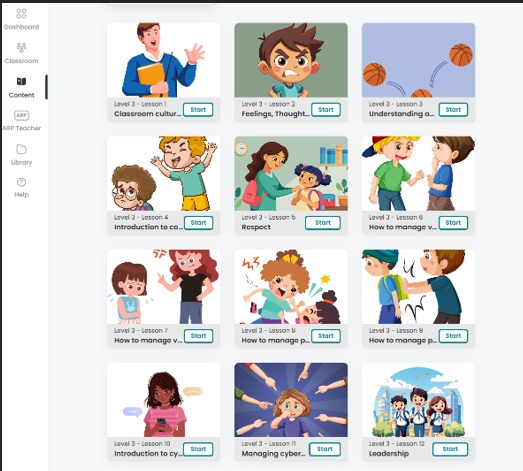
Teacher’s Portal – Sample
Junior Secondary School Level (Years 7-10)
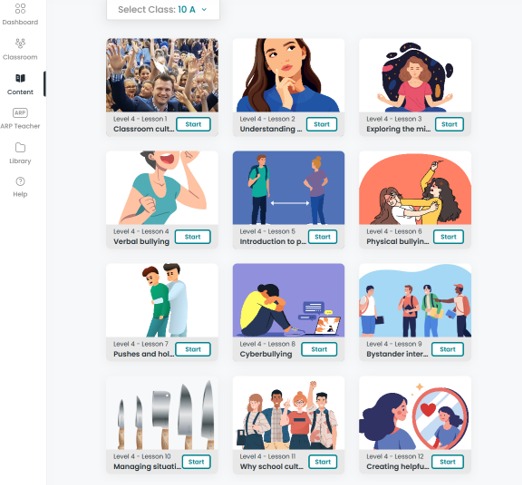

Level 4 Lesson 8
Sample Lesson Plan – Junior Secondary Level
Lesson 8 – Cyberbullying (60 minutes)
“People don’t care how much you know, until they know how much you care”
Theodore Roosevelt
Note: All lessons in levels 4 and 5 are designed as one-hour lessons, although they can be completed between 50-70 minutes to allow for variations in period length at different schools. If more time is available, it can be used to elaborate more on particular points or ask more questions from the class.
We understand that there is considerable information in the slides, which is intentional, as to change behaviour requires students to understand the “why” as well as the “how”. The slides are meant to be read/explained by the teacher – not the students. As the teacher becomes more familiar with the content, they do not have to read the slides verbatim and can explain the concepts in their own words, moving quicker through the slides where students understand the concepts and slower through the slides where more understanding is required. The delivery can be adjusted to suit the age and experience of each class, which will differ from school to school.
As teachers, you would know the importance of revising before moving onto new material. Research suggests that on average children need to be exposed to something seven times before they can understand or integrate it, highlighting the importance of revisiting key information. Please use your expertise and discretion to determine how much time students need to spend on revision, as these lessons can move at the pace that best suits your class.
Important: Teachers are powerful. This program is not just for students, it’s for teachers too. Our aim is for every teacher to feel empowered and safe and to experience the sense of achievement and fulfilment that likely originally inspired you to take on this important role.
When we say teachers are powerful, we mean it. You are the most influential person in the room. This perfectly places you in the best position to set the tone for the classroom. As such, consider what you want for your classroom. Do you want calm, engaged students? The best way to achieve this is to set the tone yourself by modelling what it looks like to be calm and engaged. Research tells us that feelings and energy are contagious, meaning that whatever you bring into the classroom, your students are likely to pick up on, and this will subsequently influence their behaviour and engagement. There is a lot of truth in the saying, “Your actions speak so loudly, I can’t hear a word you’re saying.”
Here’s some suggestions that you might like to incorporate as you deliver these lessons and as you go about embodying the crucial role of teacher:
• Adopting a firm but gentle tone.
• Keep an open posture (arms by your side rather than crossed, facing students where appropriate, head up).
– Warm, welcoming facial expressions, such as smiling and eye contact.
• Having a positive attitude (could also incorporate humour, playfulness or story telling).
• Being energetic and expressive. If you’re passionate about teaching, the students will be passionate about learning.
Overview
1. Cyberbullying – PowerPoint (52 minutes).
2. Animated video: Making you stronger and fitter. Exercises to be done during video (8 mins).
Learning objectives
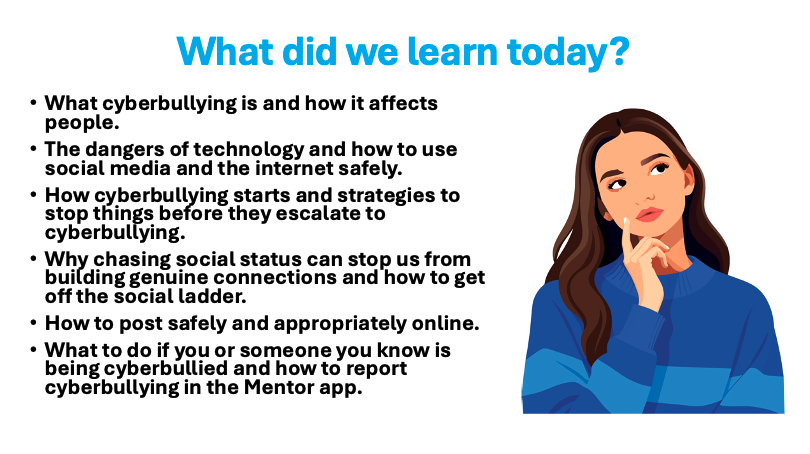
• To understand what cyberbullying is, and how it begins.
• To develop a strategy for using social media and digital technology safely.
• To understand how to respond when cyberbullying happens, including reporting.
Materials and preparation
• The room should have audiovisual facilities to play videos and a PowerPoint.
• There should be adequate room for students to participate in physical activities. Each child should have a minimum of one square metre. Children to be arranged by the teacher, who will be aware of any particular student needs. Always ensure that the designated area is safe – free of all hazards and the floor is not slippery.
Attachments/Resources
Please find the PowerPoint slides attached to the end of this lesson plan. These slides are for review purposes only to assist in preparing for the lesson. They do not include links to videos and should not be used to run the lesson. The lesson itself (containing the slides and videos) is contained in a separate file, which will only be accessible after marking attendance for that lesson, which enables Bullyproof and the school to monitor the rollout of the program at the school.
There are also handouts from the first three primary school levels available in the “Library/Files” folder of your teachers’ portal, which some secondary schools may find useful to remind students of certain behaviour principles. These documents can be used as handouts or posters (posters should be laminated) and placed somewhere on the walls in the classroom, so they can be referred to by the teacher in class whenever it is appropriate to remind students of the information covered in the program. This way, the concepts can be implemented into the classroom culture, as to improve behaviour, we must teach the students these important concepts and implement them consistently – not teach and forget.
There are also a number of A3 posters in the “Library/Culture Packs” folder, which are designed to be printed, laminated and put up in the classroom, library, assembly and other high traffic areas. These can be rotated as the culture shifts in the school to reflect the current behavioural objective of the school.
Start PowerPoint presentation here
Cyberbullying – PowerPoint (52 minutes)
This lesson introduces students to cyberbullying and provides detailed instructions on how to use the internet and social media safely.
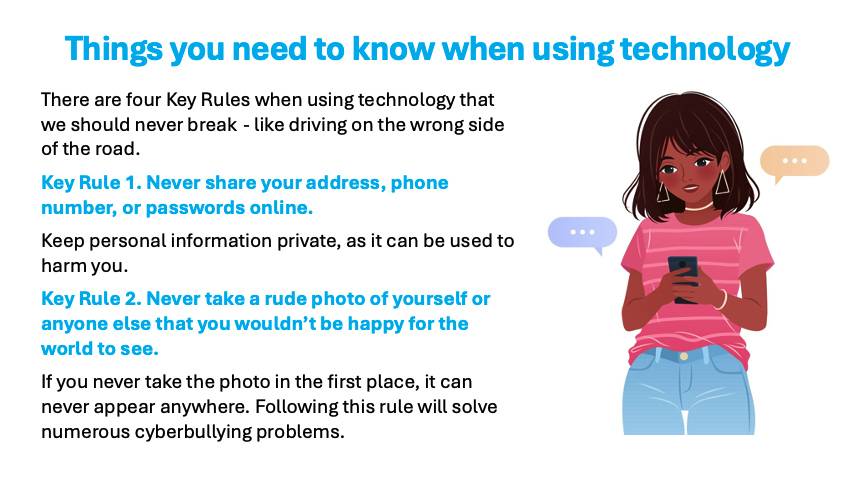
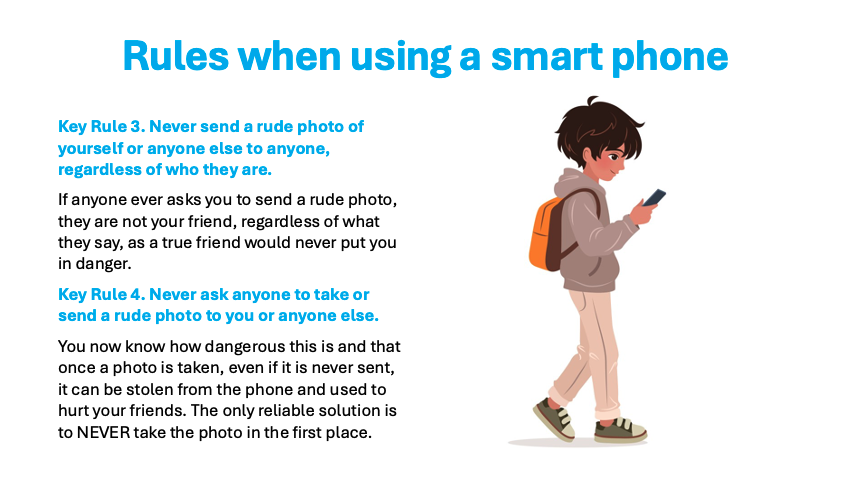
We want students to understand that it is their responsibility to use digital technology and social media in a way that respects their own and others’ safety. Much of this has to do with understanding how it works (for example that anything stored on your phone could be stolen) and using avoidance as a primary measure (such as not taking explicit photos in the first place).
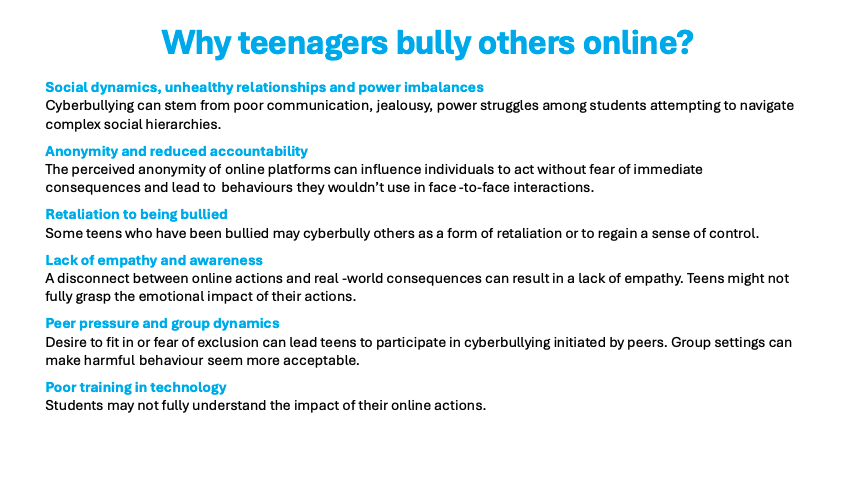
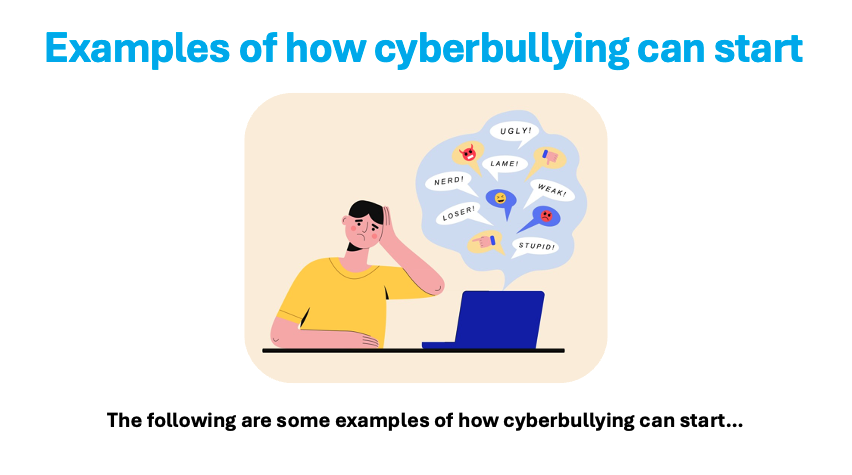
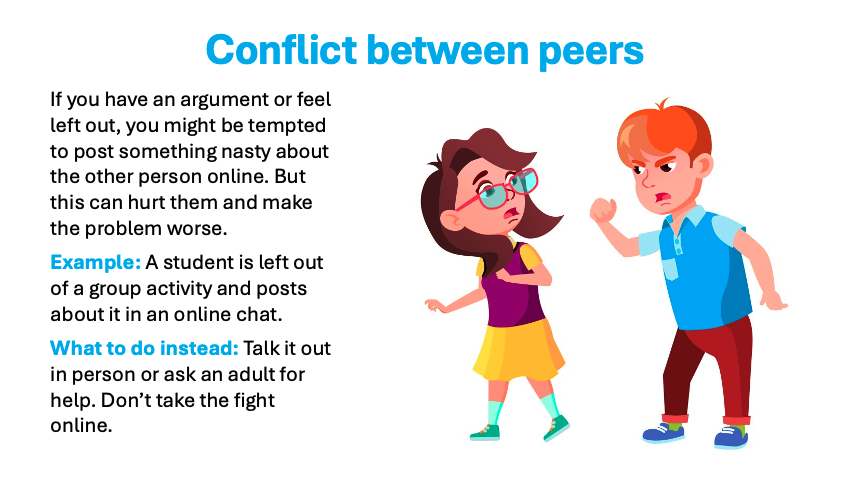
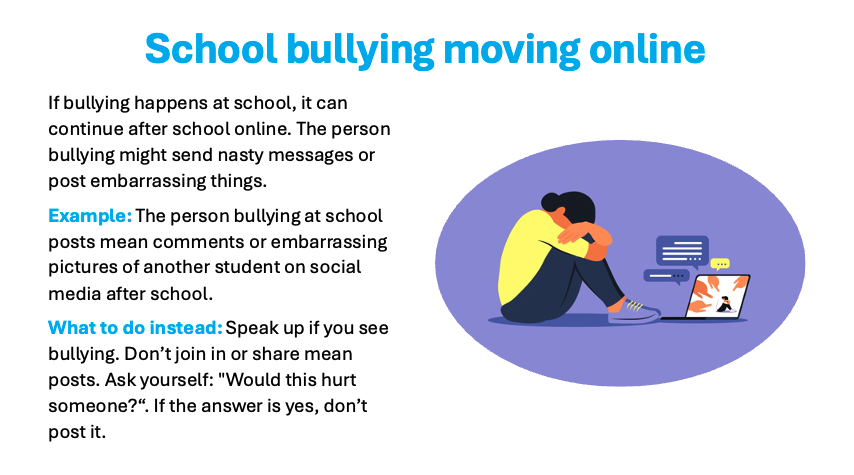
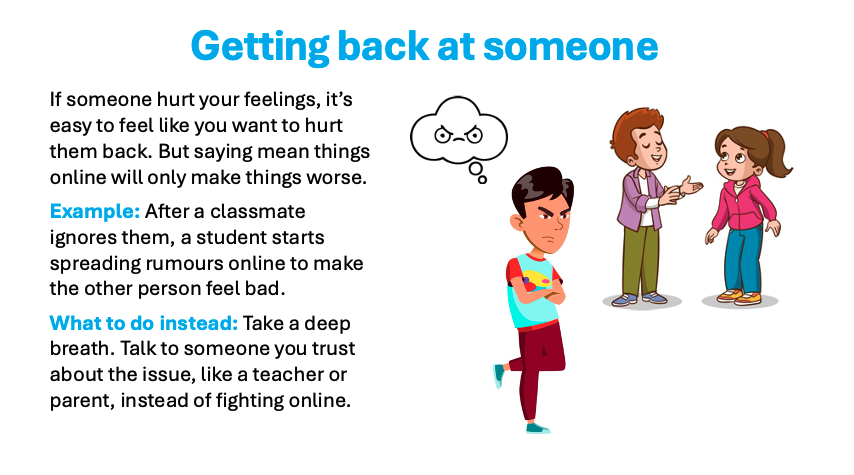
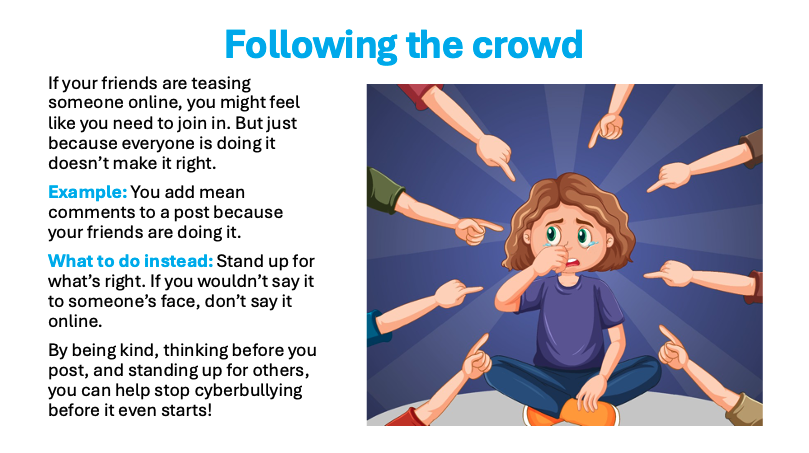
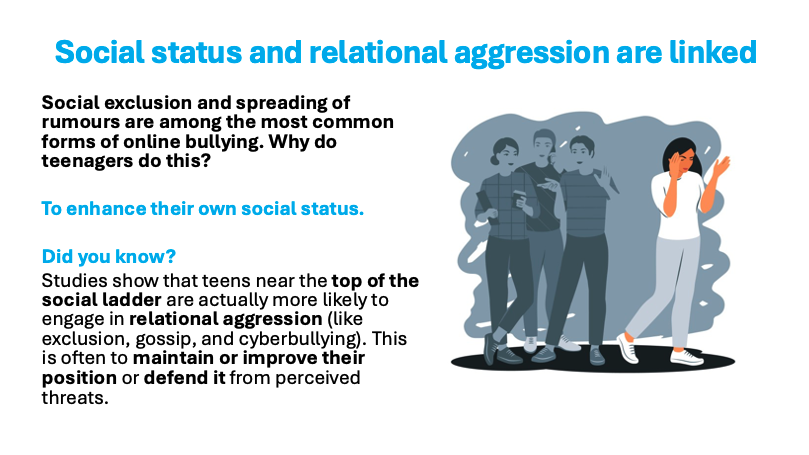
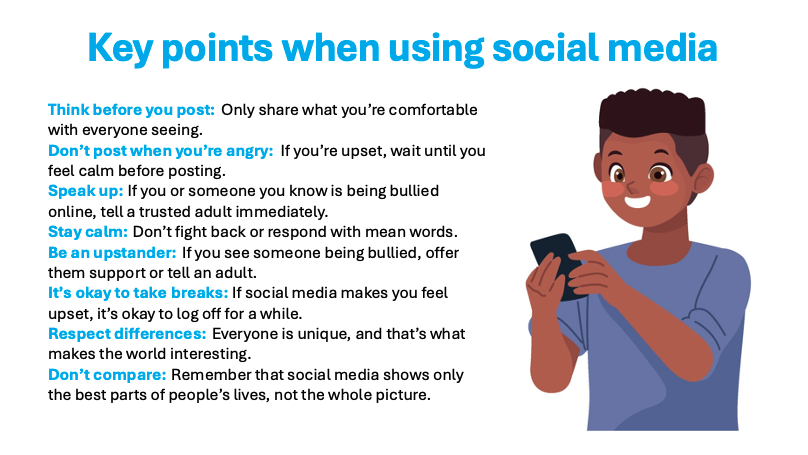
Students are guided to understand how cyberbullying starts in the first place, and it often starts with problems or conflict amongst peers. This frequently takes place at school first and then moves online. The online space is a convenient way of “getting back at someone”. It’s commonly used to embarrass, exclude or destroy someone’s reputation or self-esteem. Cyberbullying can become very serious, quickly, and in some cases, is illegal and can lead to dire consequences. Please see the link below if you would like to learn more about some of the implications with online offending:
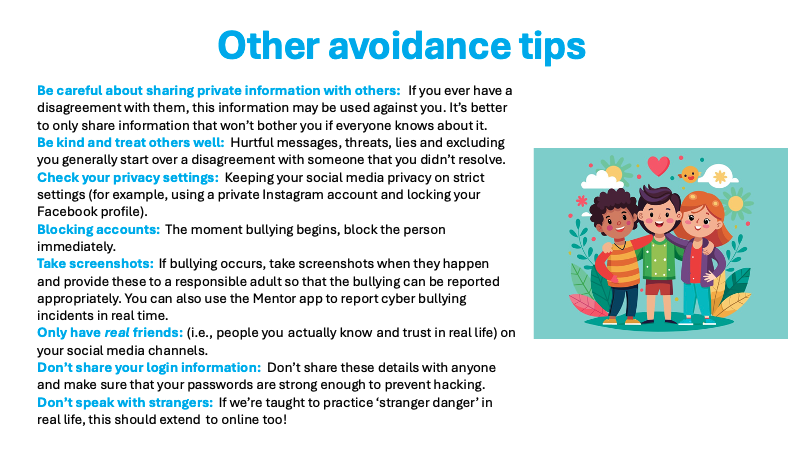
Throughout this program, there’s a common theme – that avoidance is the best strategy. When it comes to cyberbullying, there are a number of avoidance strategies students can use:
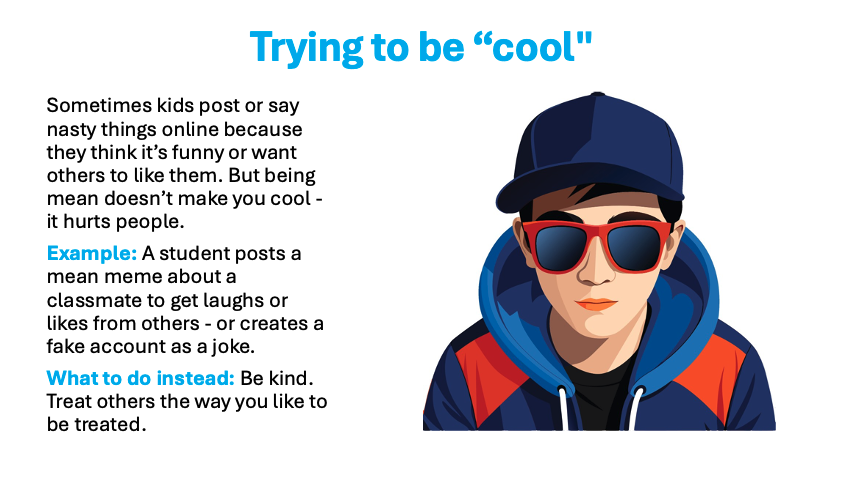
• Perhaps most importantly, be kind and respectful towards others and give them little reason to want to get back at you.
• Don’t gossip or talk badly about others and don’t post hurtful things online.
• Reduce screen time.
• Be careful what private information you share with people, either in person or online. Keep sensitive information for those you trust most, family and very close friends/mentors.
• Don’t take rude or embarrassing photos of yourself. If you aren’t happy for everyone to see it, don’t take it.
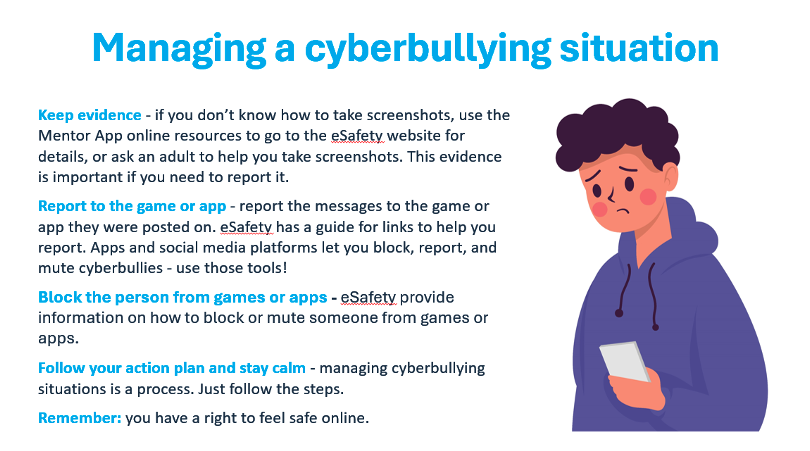
In the final section, students are provided with guidance on what to do if they have been a target of cyberbullying. It’s incredibly important that students reach out for help when this happens and then follow these steps:
• Take evidence
• Report to relevant authorities
• Block
Often students act out of emotion and block first, but this destroys the evidence. Due to the emotional nature of cyberbullying, it’s always best to enlist help. As a teacher you can offer to be that support for students, as some students have no one else to go to. Offering this support can literally save lives, as cyberbullying is closely linked to a number of suicide cases amongst young people.
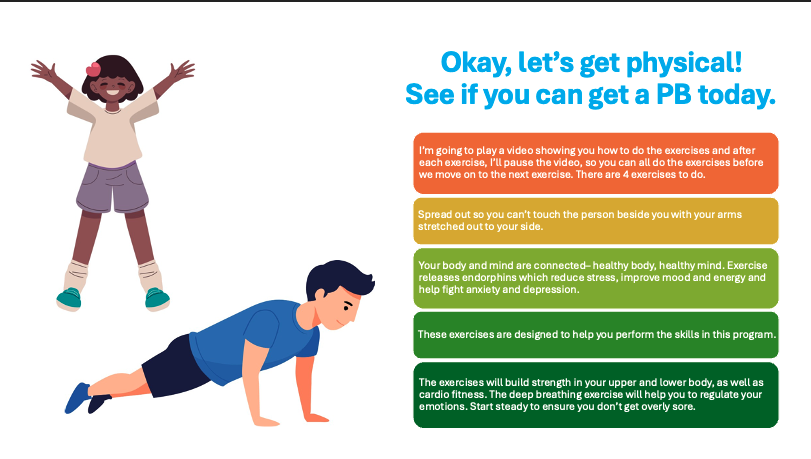
Animated Video – Making you stronger and fitter (8 minutes)
This is an animated video, which is designed to engage the children in an interactive way, so they do the exercises during the video, which you will pause when the video advises you to allow the students to do each exercise. For convenience, the video has been added into each lesson, however, if you have the same students in each lesson, you may choose not to play the video after a few lessons, as the students may know the exercises by then and you can simply tell them to complete the four exercises in their own time whilst you supervise them. It’s up to the discretion of each teacher as to how many times they play the exercise video, as every class is different.
If you do the exercises in a classroom, we suggest that enough desks and chairs are pushed to the walls, to create a large enough space to complete the exercises. Moving desks and chairs can become part of the activity, to foster teamwork and to see how quickly and orderly the children can achieve this.
The repetitions suggested in the video are a guide only. Be flexible with repetitions of each exercise and feel free to challenge more athletic children over the course of the program by steadily increasing repetitions, although please ensure that any increases are gradual to minimise muscle soreness. At the same time, there will be children less athletic who may not do many repetitions at all. It’s not a competition. It’s about steady improvement over time.
Pause the video after each exercise as directed in the video. It’s important to make the activity fun. Praise the effort rather than the results. You might like to use some of the following phrases:
• You’re all working so hard – well done!
• Wow, look at you go!
• I’m so impressed by how hard you’re all working.
Introducing exercises into the program is important for the following reasons:
• The four exercises are safe to perform and develop strength in the upper body, core and legs, as well as general fitness.
• Physical activity has links to the nervous system, making it an effective tool for regulating emotions, as well as supporting impulse control. Deep breathing is also introduced as another means to regulate feelings.
• Becoming stronger and fitter improves health, awareness and concentration. It also improves confidence.
• Performing physical activities together helps children to bond and learn to work together.
• The specific exercises chosen are designed to assist them to resolve conflict situations.
Some technical points to consider when doing the exercises are as follows:
Push-ups At primary school level, students should do these on their knees and the palms of their hands until they can do ten easily. They can then try to do some of them on their feet and hands and some on their knees. The goal is to eventually be able to do 10 push-ups, although 1-5 is quite okay. This exercise helps to build upper body strength.
Plank
Students lie on the floor and support themselves on their forearms. They lift their body off the floor and try to hold this position for 30 seconds. This exercise helps to build core strength. If children are struggling or overweight, planks can also be done on their knees until they gain the core strength to support their body. They can also bend their body more until they gain the strength to hold their body in a straight line.
Squat Jumps
This exercise builds strength in the glutes and legs. Students crouch on the floor with their fingertips
touching the floor and then spring upwards with their hands above their head and their feet off the floor,
before dropping back to the squat position and repeating for up to 10 repetitions, although some will struggle to do this many. If children are overweight and can’t squat all the way down, they can do this exercise by starting from a seated position on a chair and then just springing up from there. If, after several lessons, children find ten repetitions too easy, tell them to have a ten second break and then attempt another ten repetitions. Only very fit children should attempt more than 2 sets of ten repetitions and they should always have a ten second break between sets.
Belly Breathing
Belly breathing is a deep breathing method that is very useful at any time but even more so when children are feeling anxious, stressed or upset. It can be used as a means of regulating their emotions. It is also useful to help children relax before going to sleep.
Children with a Disability
Children who can’t do push-ups, planks or squat jumps can do isometric exercises as an alternative, such as placing one fist into the palm of the other hand at waist level and pushing up with one hand and down with the other. This can then be reversed so they are pushing up with the other hand. Another isometric exercise is to lift the elbows to the height of the shoulders and push one fist into the other palm. Interlocking the fingers at waist level and pulling the arms outward is another.
Sample - Lesson Slide Presentation Delivered Through Teachers' Portal